Desecration
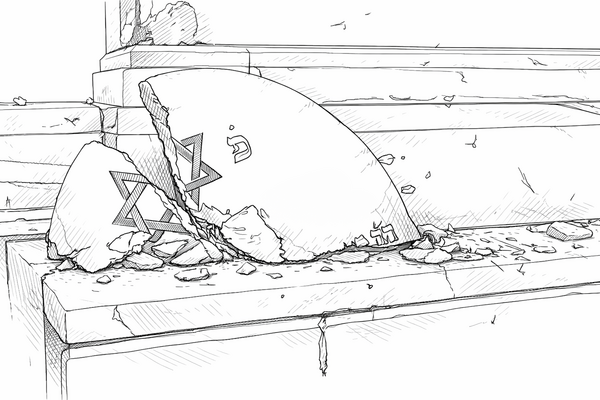
Attacks on Jewish cemeteries have been taking place for centuries. Gravestones have been knocked over, inscriptions destroyed, and graves defaced—often by people whose actions were portrayed or perceived as youthful exuberance or mere vandalism. But the deliberate choice of Jewish sites shows that these actions are not random, but rather the result of deep-rooted anti-Semitism. This module explores what desecrations mean and how we should deal with them.
Learning
Learning Goals
Introduction

Jewish cemeteries are more than just burial grounds—they are places of collective memory. In Jewish tradition, they are considered “eternal resting places” that cannot be removed or built over. Each grave tells a story and represents lasting respect for the deceased. When such places are damaged or desecrated, it affects not only stones and walls, but the very foundation of memory itself.
Despite this special significance, attacks on Jewish cemeteries have been a reality for centuries. Time and again, gravestones have been knocked over, inscriptions destroyed, or graves defaced – often by people who portrayed their actions as youthful exuberance or mere vandalism. But the deliberate choice of Jewish sites shows that these actions are not random, but rooted in deep-seated hatred. The difference from other forms of destruction is that the anger here is directed against a religious and cultural symbol – against the memory of Jewish life.
This violence did not end after 1945. On the contrary, in the post-war decades, the number of attacks increased, even though – or perhaps because – many Jewish communities no longer existed. Abandoned cemeteries became silent witnesses to the Holocaust and, at the same time, targets for people who took issue with the culture of remembrance itself. Even in the 2000s, Jewish cemeteries in Germany were desecrated more than once a week, according to statistics. These figures make it clear that anti-Semitism is not a historical relic, but an ongoing social problem.
The desecration of Jewish cemeteries is an expression of this continuity of hatred. It shows that anti-Semitism persists even where it encounters death and remembrance. That is why such acts are not only attacks on the past, but also a challenge to the present to be aware of this hostility and to oppose it decisively.
Info
Anti-Semitism describes a way of thinking that views Jews as fundamentally alien or harmful. While earlier forms were based on religion, a political variant developed in the late 19th century that portrayed “the Jews” as the supposedly powerful cause of economic or social ills. After World War II, this way of thinking changed again: today, it manifests itself in the denial of the Holocaust or the rejection of the State of Israel, for example.
Quiz
Which statement best describes why desecrations of Jewish cemeteries are perceived as particularly distressing?
SORRY, THAT'S WRONG!
SORRY, THAT'S WRONG!
CORRECT
In Judaism, cemeteries are considered “eternal resting places.” Graves are not removed or reused, but remain as a sign of respect. Desecration therefore means not only physical destruction, but also an attack on cultural memory and the dignity of the deceased—something that is experienced as particularly painful.
Why did desecrations of Jewish cemeteries not decrease after 1945, but in some cases even increase?
CORRECT!
After the Holocaust, there were no longer any active Jewish communities in many places, meaning that cemeteries were largely neglected. These sites became particularly attractive to perpetrators who wanted to express their hatred of Jews or the memory of Nazi crimes. Desecrations were thus also directed against the newly emerging culture of remembrance.
SORRY, THAT'S WRONG!
SORRY THAT'S WRONG!
Why is the desecration of Jewish cemeteries considered an expression of anti-Semitic attitudes?
SORRY, THAT'S WRONG!
CORRECT!
Anti-Semitism is directed not only against living Jews, but also against their history, culture, and places of remembrance. Cemeteries are central symbols of Jewish community and are considered “eternal resting places.” Anyone who damages them is therefore deliberately attacking a religious and cultural foundation. Desecrations thus act as a mirror of anti-Semitic stereotypes: hatred even transcends the boundary of death and turns against what particularly protects and unites Jews—their collective memory.
SORRY, THAT'S WRONG!
Dealing With Cases of Desecration
Understanding and responding to acts of desecration at the Jewish Cemetery in Görlitz
Desecrations do not only attack individual gravestones – they always affect memory, community, and cultural heritage. The Jewish Cemetery in Görlitz is an important place of remembrance. Your task is to find out how it was attacked in the past and how we can deal with this today.
Subtask 1: Research on cases
Find specific examples of desecrations at the Jewish Cemetery in Görlitz. Pay particular attention to acts such as the toppling of gravestones, graffiti, theft, or other deliberate destruction.
- This website offers a virtual tour of the Jewish Cemetery in Görlitz.
During this tour, you can discover some visible traces of previous desecrations, such as overturned or damaged gravestones. Pay attention to which inscriptions or decorations are missing, which stones are broken, or where obvious defacement has been documented.
- Use the website map.net-olam.de
There you will find documentation of previous damage under the entry for the Görlitz Jewish Cemetery.
- Also do some research in local press archives (Sächsische Zeitung, Niederschlesien Kurier, Radio Lausitz, or MDR).
- You might find:
Incidents such as overturned gravestones, extensive damage during the 20th century, theft of metal parts, or more recent minor acts of vandalism.
Subtask 2: What happened and what were the consequences?
Describe what happened in each incident and what the consequences were. Were you able to find out how the local community or the media reacted? Was there solidarity, public debate, or measures taken to restore the cemetery?
- Clearly describe the nature of the incident (use the W questions).
- Check whether there are reports of
- police investigations,
- public expressions of solidarity,
- restoration work, or
commemorative initiatives.
Use information from journalistic sources or from the virtual tour on this website, which describes when certain damage occurred and how it was repaired.
- Consider:
- Was it publicly condemned? By whom?
- Was the damage repaired, and if so, how?
Possible findings:
Such acts of desecration are often not classified as anti-Semitic acts. Restorations often take a long time and are expensive. Only rarely has there been a reaction from society or politicians.
Subtask 3: What could prevent desecrations in the future?
Consider what measures could help prevent future desecrations. Possible solutions include technical measures, educational programs, community projects, or publicly visible signs against anti-Semitism.
- Educational and social prevention:
- cooperation with schools (e.g., sponsorship programs for older graves),
- project weeks on Jewish history,
- workshops against anti-Semitism,
- Political and civil society measures:
- clear positioning of the city against anti-Semitism,
- joint actions by associations, churches, and youth groups to preserve the cemetery as a place of remembrance,
Hint:
Consider which measures complement each other. A combination of education, participation, and protective measures usually has the strongest effect.
Info
If you notice anything in the cemetery that could be considered desecration, please report it to the following authorities:
Friedhofsverwaltung - Cemetery Administration of the City of Görlitz
Jüdische Gemeinde zu Dresden - Jewish Community of Dresden
If you are certain that it is a case of desecration, you can also file a report directly with the Saxony police - bei der Polizei Sachsen eine Anzeige erstatten.
It is also advisable to report the incident to the RIAS Saxony anti-Semitism reporting center - RIAS Sachsen

In the virtual tour of the Görlitz Jewish Cemetery, anti-Semitic graffiti is documented on the Cohn family grave, which probably dates back several decades but clearly bears neo-Nazi symbolism. It was brought back into public consciousness through the research and public work of Lauren Leiderman, among others. In a Facebook post, she highlighted the graffiti and explained why even older, “forgotten” graffiti is serious: it is directed not only against the deceased, but against the entire Jewish community. An accompanying article in the Sächsische Zeitung (paywall) confirmed that the graffiti is right-wing extremist and that similar symbols have been found in the cemetery in the past. This detracts from the historical character of the cemetery and at the same time shows how lasting anti-Semitic attitudes can be.
The desecration did not consist of destroying the gravestone, but rather of applying an extremist symbol. Nevertheless, the consequences are serious: such graffiti violates the memory of the people buried there and disturbs the dignity of the place. For relatives, descendants, or people involved in Jewish culture, anti-Semitic symbols are particularly distressing, as they represent a continuation of exclusion, hatred, and degradation. In addition, a cultural monument whose historical and religious significance extends far beyond the city of Görlitz has been damaged. The graffiti points to the persistence of anti-Semitic attitudes and shows how low the threshold can be to target even the dead.
The reactions to the discovery of the graffiti were particularly influenced by civil society: committed individuals such as Lauren Leiderman made the incident public, drawing new attention to the cemetery. The grave has since been thoroughly cleaned by the city. There have also been increased efforts to make the history of the people buried there more visible and to better protect the cemetery. Maintenance campaigns, Mitzvah-Days, and guided tours have since contributed to a better understanding of the site, conveying its historical context and encouraging broader participation. Such initiatives send a signal that anti-Semitic desecrations will not be ignored, but consciously addressed.
This example gives rise to various preventive approaches. Educational programs that explain the significance of Jewish cemeteries for remembrance culture and why attacks on gravestones are much more than mere vandalism are particularly important. The digital tour and disclosure of individual cases help to create transparency; they show the public what has happened and prevent such acts from being trivialized. Regular documentation of the gravestones, for example through photos or digital 3D models, facilitates the monitoring of changes and can serve as a basis for identifying and reporting possible desecrations more quickly. In addition, the involvement of the urban community—for example, through sponsorships for graves, workshops against anti-Semitism, or cooperation with schools—promotes a sense of responsibility for the protection of the cemetery. Technical measures such as regular checks can have a complementary effect without restricting the cemetery as an open place of remembrance.